AIM researchers win Task A of the first DAFx Challenge
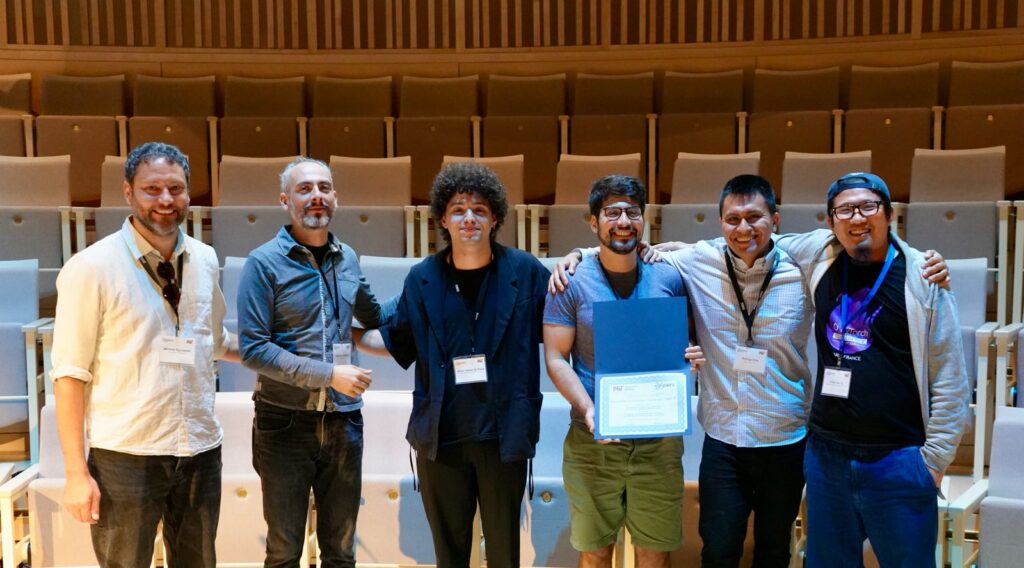 We are excited to announce that a team of AIM researchers comprised of David Marttila, Rodrigo Diaz, Pablo Tablas De Paula, Ilias Ibnyahya (C4DM), and Chin-Yun Yu has won Task A of the first DAFx Parameter Estimation Challenge. The challenge was held as part of the Digital Audio Effects Conference DAFx26, which took place in Cambridge, Massachusetts, on 1–4 September 2026.
Plate reverberators create reverberation through the vibrations of a metal sheet. Their digital counterparts simulate this behaviour, allowing different reverberant sounds to be generated by changing the model’s parameters. The challenge turned this process around: given only a simulated plate’s impulse response—the sound it produces following a brief excitation—could participants recover the parameters that generated it?
Task A focused on six physical and geometric parameters describing the plate and the position at which its vibrations are measured. To tackle this, the team generated more than 327,000 synthetic impulse responses and developed two approaches combining Transformer-based machine learning with physical modelling. Both analyse several aspects of the sound, including its frequency content, initial waveform and decay over time.
The first approach uses a neural network to predict an initial set of parameters. A differentiable plate simulator then allows these estimates to be adjusted step by step, using the difference between the simulated and target waveforms to guide each update. The second uses a generative neural model to propose several possible parameter sets. These candidates initialise a particle swarm optimisation process, in which a population of candidate solutions searches for a closer match, followed by a final gradient-based refinement.
In their published results, organisers Leonardo Gabrielli and Michele Ducceschi report that the second approach ranked first, recovering the simulated plate’s parameters to machine precision on the official test set. The first approach placed fifth under the official mean-error metric and would rank third by median error, with a few difficult cases accounting for the difference.
Task B presented a different challenge: recovering the plate’s individual resonances, or modes. Participants had to estimate how many modes were present, their frequencies, how quickly they decayed and their gains. With potentially thousands of overlapping resonances contributing to a single sound, even determining how many to look for is difficult.
The team developed two count-density networks that learn to estimate the total number of modes and their distribution across frequency bands, alongside their decay rates and gains. One uses a convolutional U-Net that combines spectral magnitude and phase information with features from the waveform. The other uses a complex-valued Transformer to process the spectrum while retaining its magnitude and phase structure. Both assemble their modal estimates directly from the network predictions, without running an iterative plate simulation for each new response.
The task B method proposed by the AIM team achieved high scores and came in second place. The organisers’ analysis also highlights an open problem: estimating modal gains remained substantially harder than recovering frequencies and decay rates, and a perceptually similar estimation can produce a different ranking. The results therefore show both the promise of the approaches and where further work is needed.
Congratulations to the team on the Task A win and their strong results across both tasks!