The AIM CDT Outcomes go beyond publications and graduating students. We want to highlight some of these outcomes.
Prizes and Recognitions
These included the AIM Best Paper Award at EvoMUSART 2025; Best Paper Awards at ISMIR 2024 for work authored by AIM students (including MuChoMusic: Evaluating Music Understanding in Multimodal Audio-Language Models and ST-ITO: Controlling audio effects for style transfer with inference-time optimization); Best Student Paper Award (Saurjya Sarkar) and Best Paper Award (Christian Steinmetz) at WASPAA 2023; Outstanding Reviewer recognition for Jiawen Huang and Christian Steinmetz at ICASSP 2023; Best Paper Award at DAFx 2022 for Differentiable Time-Frequency Scattering on GPU (Cyrus Vahidi); and Best Reviewer Awards at ISMIR 2021 for Ilaria Manco and Ben Hayes.
Students also received recognition beyond academic conferences. Examples include MIDI Innovation Awards (2023) awarded to Andrea Martelloni and Max Graf; a QMInnovation grant awarded to the same recipients; third prize at the 25th Guthman Musical Instrument Competition (Georgia Tech, 2023) awarded to Andrea Martelloni; winning the 2023 International Synth Design Hackathon (James Bolt), with an invitation to present at Superbooth in Berlin; a UK–Canada Globalink Doctoral Exchange Scheme grant awarded to Adan Benito for a research visit to McGill University; and eight Alan Turing Institute enrichment scheme awards granted to AIM students.
Individual Case Studies
Katarzyna Adamska
Predicting Eurovision Song Contest Results
↗ Read more
Huan Zhang
LLaQo: Towards a query-based coach in expressive performance assessment
↗ Read more
Luca Marinelli
Yes, Musical Sounds Can Be SEXIST
↗ Read more
Madeline Hamilton
Science for Everyone: Bringing Evidence into Popular Music Debates
↗ Read more
Communication
Katarzyna Adamska
Predicting Eurovision Song Contest Results
Supervisor: Joshua Reiss
About the project
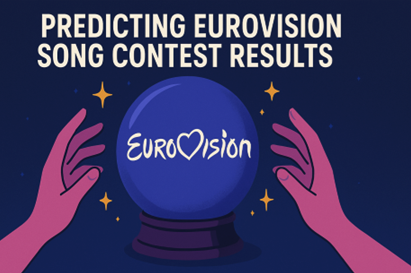
This project develops a framework for predicting Eurovision Song Contest results, focusing on both semi-final qualification and final rankings. It can be considered a ‘hit song’ prediction task as it analyses data to forecast the success of a song. Instead of using commercial music charts, this work explores the unique dynamics of Eurovision by integrating diverse data sources.
The prediction model combines intrinsic song features (such as audio and lyrics characteristics) with indicators of public appeal (e.g., YouTube daily views) and contest-specific factors (including voting patterns and performance order). Using data from contests spanning 2008 to 2024, the study evaluates multiple feature sets to determine their predictive power.
Results highlight that song characteristics alone are insufficient for accurate ranking prediction, while models integrating musical, social, and contextual information achieve the highest consistency and accuracy. The framework contributes to a deeper understanding of what drives success in popular music.
Description of Impact
The project has generated some media interest. The university’s media team published press releases about the research in 2024 and 2025, and in 2025, the BBC invited me for a live interview featured in their Countdown to Eurovision programme. The project’s appeal stems from its connection to a renowned international music event and from the novelty of the predictive framework, which had not previously been implemented or discussed in this context. Overall, I would describe the impact as media-friendly and highly accessible to a broad audience.
The paper was also presented at the 26th International Society for Music Information Retrieval Conference (ISMIR 2025) in Daejeon, South Korea, this year.
Who was impacted
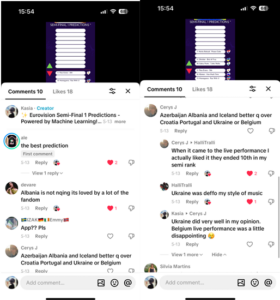
The project received an enthusiastic response from both the academic community and the general public, particularly among Eurovision fans. Some people, regardless of their background in music or AI, expressed interest in comparing their own predictions and learning about my prediction framework. Engagement occurred through both in-person conversations and interaction on social media platforms, demonstrating the project’s reach beyond academic circles.
Publication
Adamska, K., & Reiss, J. (2025). Predicting Eurovision Song Contest Results: A Hit Song Science Approach. Transactions of the International Society for Music Information Retrieval, 8(1), 93–107. DOI: 10.5334/tismir.214
Development · Commercialisation
Huan Zhang
LLaQo: Towards a query-based coach in expressive performance assessment
Collaborators: Simon Dixon, Vincent Cheung (Sony CSL), Shinichi Furuya (Sony CSL)
About the project
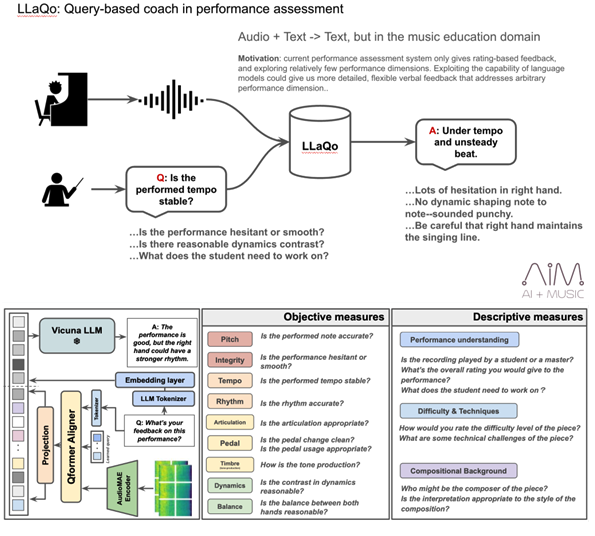
This project presents LLaQo, a Large Language Query-based Coach for automatic assessment of expressive music performance. LLaQo combines an audio encoder and a language model to interpret a musician’s playing and generate natural-language feedback on aspects such as tone, dynamics, and phrasing. Trained on an instruction-tuned dataset linking performance recordings with teacher-like comments, the system learns to reason about musical expressivity beyond accuracy-based scoring. Evaluations using the NeuroPiano dataset show that LLaQo produces feedback rated by experts as more informative and human-like than existing methods. The project advances AI-assisted music education by enabling interpretable, language-driven coaching that supports both self-learning and formal teaching contexts.
Description of Impact
This project has attracted significant industry and entrepreneurial interest beyond academia. Three AI startups have approached me for collaboration and potential spin-out opportunities based on the LLaQo framework, highlighting its commercial potential in AI-assisted music learning and performance evaluation.
The model’s ability to provide interpretable, language-based feedback has also drawn attention from the Associated Board of the Royal Schools of Music (ABRSM), with whom I am currently involved part-time with their project “Music Performance Assessment and Feedback”, exploring the integration of their graded performance data to train a similar framework.
Who was impacted
The project engaged a broad community spanning both academia and industry. Early prototypes of LLaQo were shared with music educators and performing musicians, who used the system to receive AI-generated feedback on phrasing, tone, and expressivity. Industry partners, including three AI startups, expressed interest in adapting the framework for commercial applications in music training platforms. Additionally, ABRSM educators and examiners are collaborating to evaluate LLaQo using real student performance data, with the goal of improving feedback quality in graded exams. The work has also inspired students and researchers interested in the intersection of artificial intelligence and music pedagogy.
How could this work be taken further?
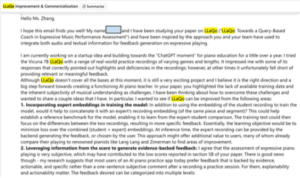
I am currently exploring a partnership with ABRSM to integrate LLaQo with their large-scale performance datasets, enabling data-driven feedback for graded music exams and expanding the model’s educational impact.
I have been awarded a six-month postdoctoral fellowship to extend this work toward adaptive, multimodal feedback systems for instrumental learning.
Quantitative evidence of impact
835 dataset downloads · 91 GitHub stars · 236 full-text views (ICASSP paper) · 4 citations · 48 LinkedIn reactions
Publication
Zhang, H., Cheung, V., Nishioka, H., Dixon, S., & Furuya, S. (2024). LLaQo: Towards a query-based coach in expressive performance assessment. Proceedings of ICASSP 2025.
Communication
Luca Marinelli
Yes, Musical Sounds Can Be SEXIST
Collaborators: Charalampos Saitis, Petra Lucht
About the project
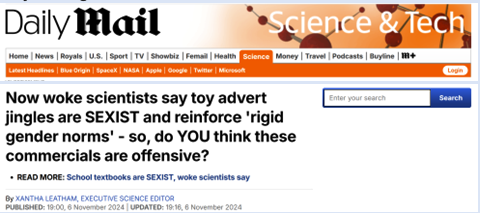
Music can be imbued with distinct identity dimensions upon which ideological discourses are promulgated. Gender is one of these identity dimensions, while androcentrism and heteronormativity are its hegemonic ideological discourses. Multimodal genres—which underlie this phenomenon in media portrayals—describe “regular patterns of semiotic choices in multimodal communicative objects and events that are particular to specific communities and cultures”. Toy commercials are organised in distinct gender-based multimodal genres.
Luca collected ratings from a total of 300+ people on 606 toy TV commercials. The collected ratings addressed each commercial’s affective and musical characteristics, and strong gender polarisation was observed in nearly all of the collected variables. Gendered music styles in toy commercials exhibit synergistic design choices, as music in masculine-targeted adverts was substantially more abrasive—louder, more inharmonious, and more distorted—than in feminine-targeted ones.
For those interested in exploring the data further, the following two interactive maps allow users to see the toy commercials and the music analysis firsthand:
📅 Music-focused interactive map
📅 Multimodal emotions interactive map
(Refresh if the page does not load immediately)
Description of Impact
Already three decades ago, Lucy Green wrote that “gendered musical meanings affect our consciousness and experience, not only of music, but through music, of ourselves. Gendered musical meanings participate in the construction of our very notions of masculinity and femininity.”
While much attention in advertising research has been given to the overt sexualization and objectification of visibly non-disabled women, this study underscores the equally insidious impact of enforcing rigid gender stereotypes, particularly in advertisements targeting children.
The research has been covered by major news outlets, bringing the discussion from academia to the general public and providing empirical evidence that gendered meanings can be encoded in musical material across various media, including toy commercials, movies, video games, and educational materials.
Who was impacted
It has had an impact on the mainstream discussion on gender norms, and anyone interested in engaging critically with it. In addition, it can help parents of young children to be more aware of how media can impact the affective and social development of their child.
How could this work be taken further?
Following a 2017 UK report on gender stereotypes in advertising, the Committee of Advertising Practice (CAP) and the Broadcast Committee of Advertising Practice (BCAP) introduced a rule in the UK Advertising Codes prohibiting harmful gender stereotypes in advertising, effective from 14 June 2019. A 12-month review confirmed the rule’s effectiveness, leading to its retention with added clarification that would initially offer guidance only for cases involving sexualization, objectification, and body image. This highlighted the need for further monitoring of areas where guidance was insufficient, particularly in relation to ads targeting children and other vulnerable groups.
Our systematic analysis of multimodal gender stereotypes provides policymakers with quantitative evidence to support targeted interventions.
In the media
📄 Daily Mail (UK) — 127 comments
📄 RTBF (Belgium, French)
📄 La Dépêche du Midi / Voxeurop (France)
📄 Der Spiegel (Germany)
📄 ANSA (Italy)
📄 IFLScience (UK) — 230 shares
📄 Science Daily (US)
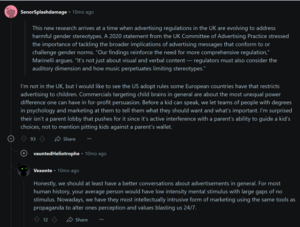
📄 Reddit r/science — 643 upvotes, 59 comments
Publication
Marinelli L, Lucht P, Saitis C (2024). A multimodal understanding of the role of sound and music in gendered toy marketing. PLoS ONE 19(11): e0311876. DOI: 10.1371/journal.pone.0311876
Communication
Madeline Hamilton
Science for Everyone: Bringing Evidence into Popular Music Debates
Supervisor: Marcus Pearce
About the project
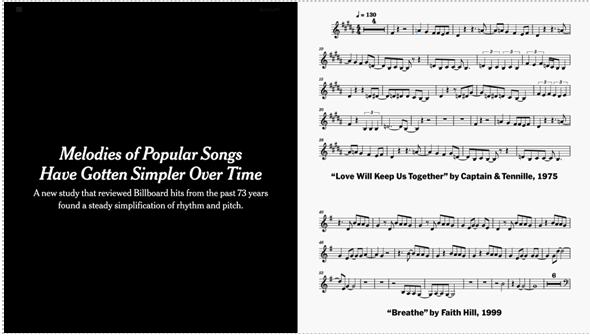
As part of her research, Madeline created the Billboard Melodic Music Dataset, a MIDI dataset of the main melodies of the top five singles from the Billboard Year-End Singles Charts for each year from 1950 to 2022. She analysed the dataset to examine how various features of the most popular melodies have changed over time. The work was published in Scientific Reports in 2024.
The key takeaway is that the complexities of vocal melodies in the most popular songs have decreased significantly since 1950. The analysis provides quantitative evidence that these changes are indeed happening. However, Madeline points out that it is not a judgement about the overall artistic value or quality of music.
Description of Impact
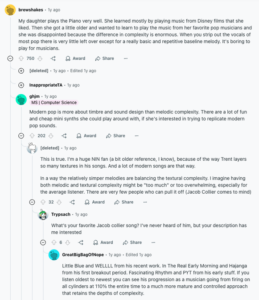
Madeline’s research reached a broad audience beyond academia through wide coverage by national and international news outlets like The Guardian or The New York Times. By applying data-driven methods, her work injected a more objective, evidence-based perspective into public discourse about popular music. It encouraged readers to challenge common assumptions and engage critically with the findings which led to lively discussions on social media platforms like Reddit and X. Some praised the research for its clarity and innovation, while others offered constructive critiques, reflecting a meaningful exchange of ideas.
This project brilliantly showcases how research can influence public discourse and motivate people to engage more deeply with scientific methods. Madeline is deeply motivated by producing accessible insights that are of interest beyond a niche community because in her opinion science is a conversation for everybody.
Who was impacted
People of the general public who engage with the news and have some interest in popular music and culture.
How could this work be taken further?
The dataset could be licensed for companies who want to use it for commercial ventures like training GenAI models.
Quantitative evidence of impact
Over 16,000 paper downloads (73rd most downloaded paper in 2024 from Scientific Reports) and an Altmetric score of 1,614, with over 200 news articles written about the article according to Altmetric.
Coverage by major radio and TV stations reaching millions of listeners including The Pat Kenny Show, Australian National Radio (ABC Regional Drive Western Australia), German Radio (Deutschlandfunk Kultur), detektor.fm, NPR’s Morning Edition, and New Zealand national TV (TVNZ Breakfast).
Coverage by major newspaper outlets reaching millions of readers including two articles by The Guardian, New York Times, The Independent, Smithsonian Magazine, Metro UK, El País and Tagesspiegel.
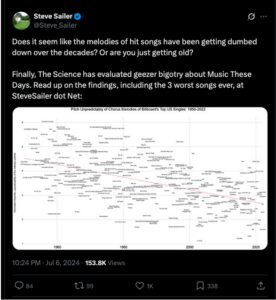
Video by YouTuber Mic the Snare with 100,000+ views and 500+ comments. Reddit discussions on r/science (2,100 upvotes, 200+ comments) and r/popheads (328 upvotes, 100+ comments). Twitter thread with 153,000+ views and 80+ comments that includes a visualisation of the dataset by a member of the public. 100+ emails that Madeline received from members of the public about her work.
Qualitative evidence of impact
The comments on social media and direct emails can be summarised as follows: discussion about why these changes may be occurring; genre shifts; popular music increasingly becoming “lowest common denominator”; increased use of sampling in music; complexity does not equal quality; people always think current pop music is bad regardless of the era.
Publication
Hamilton, M., Pearce, M. Trajectories and revolutions in popular melody based on U.S. charts from 1950 to 2023. Sci Rep 14, 14749 (2024). DOI: 10.1038/s41598-024-64571-x